
The floor has moved: Rethinking work in an AI-first world

Somewhere between the first draft that wrote itself and the debugging session that took thirty seconds, something fundamental changed.
“Work no longer begins from a blank page. It begins with a prompt, a draft, or a suggestion already in motion.”
This is not about AI potential. It is about what happens after adoption, when tools stop being impressive and start becoming embedded in how work actually gets done. Most conversations about AI at work remain hypothetical. This one is not. This article is based on internal survey insights across engineering teams at VRIZE.
Not long ago, using AI meant stepping outside the workflow. It was a separate tab, an occasional assist, a way to save time on specific tasks.
That model no longer applies at scale.
AI is now embedded directly into the flow of work. It is where drafts begin, where debugging starts, where research is structured, and where analysis takes shape. It is no longer a tool that is consulted. It is part of how work is executed.
Internal survey data reflects this shift. More than 85% of respondents report using AI multiple times a day across technical work, documentation, research, and strategic thinking. This is not task-level adoption. It is workflow-level integration.
One employee put it simply: “AI has been my personal assistant for everything, be it technical, functional, or strategic.” That is not a productivity hack. It is how work is done.
The productivity impact is significant.
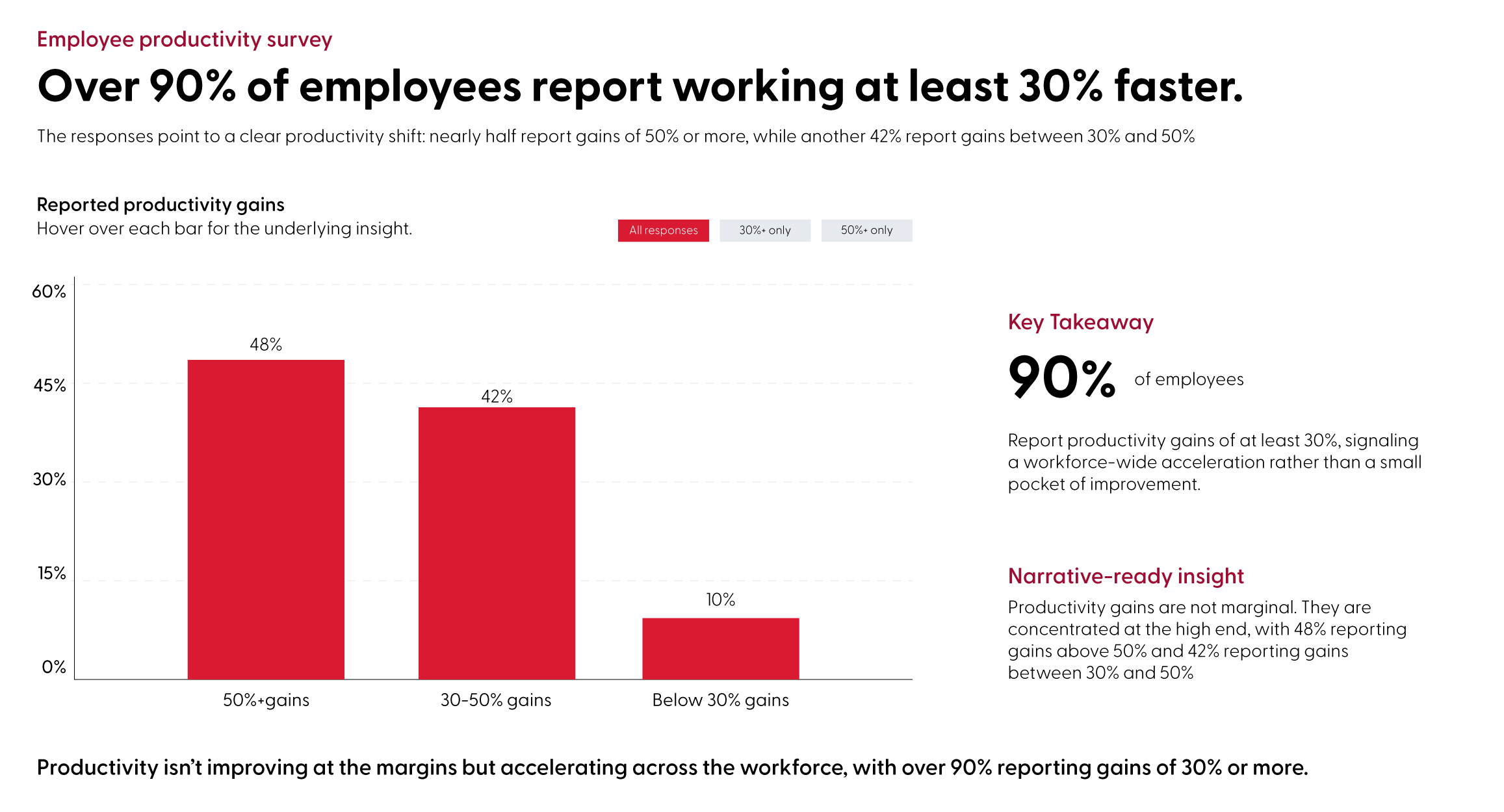
Nearly half of respondents report productivity gains of 50% or more, with over 90% seeing at least a 30% improvement.
This is not incremental efficiency. It is a step change in how work is executed.
This aligns with patterns we are seeing across enterprise teams as AI moves from experimentation to execution.
More importantly, the nature of work is changing. AI is absorbing the foundational layer of tasks, allowing human effort to shift toward judgment, decision-making, and design.
The value of time is being reallocated, not just optimized.
This reflects real AI workforce transformation, not a quarterly boardroom discussion, and as one employee puts it: “Simply put, work that previously took two hours can now be completed in minutes with the help of AI.”
Despite deep integration, trust in AI outputs is not absolute.
Around 44% of respondents describe themselves as somewhat confident in AI outputs, while a significant portion remains neutral. High confidence is limited, and that is not a weakness.
It reflects maturity.
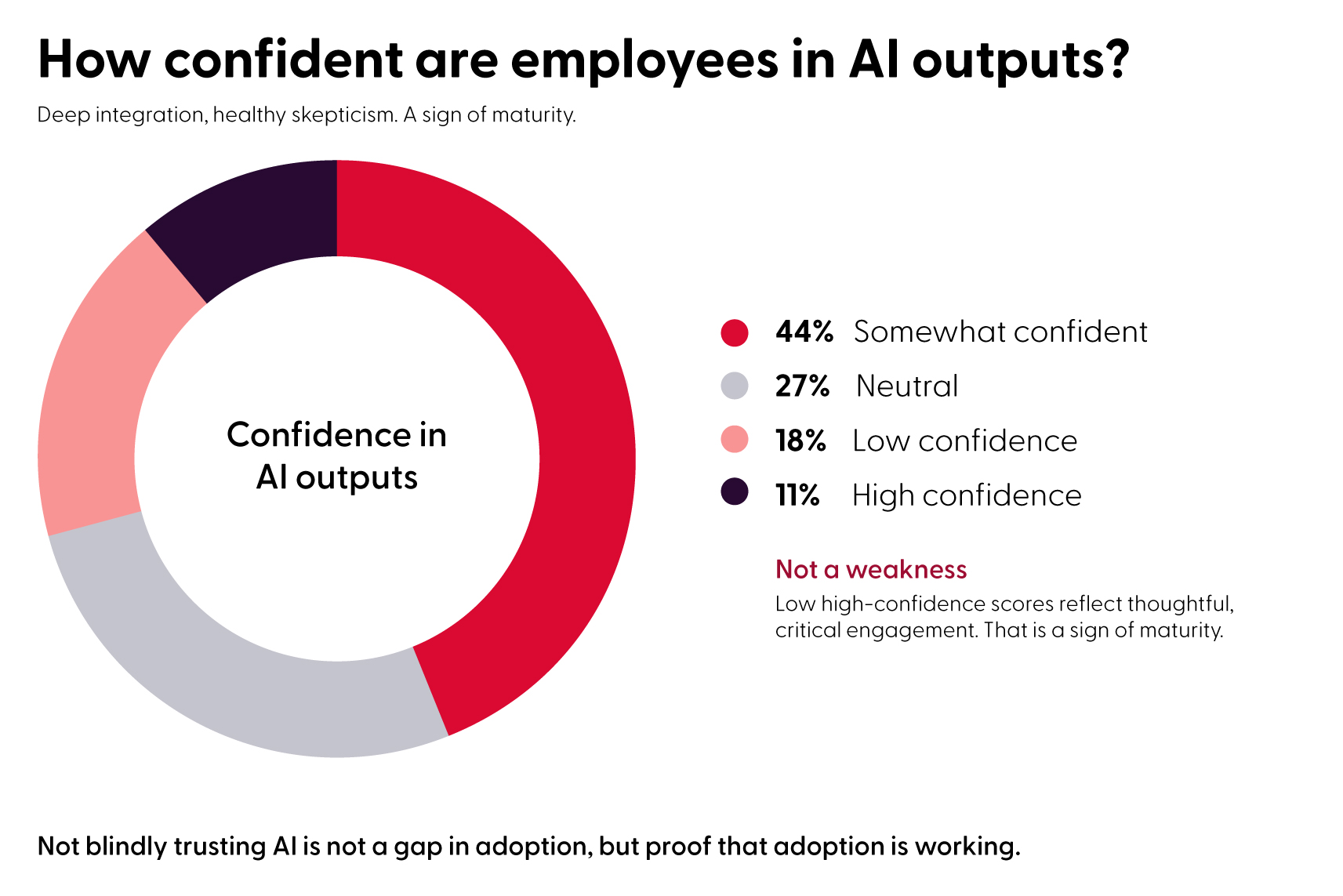
AI is being used as a collaborator, not an authority. Outputs are reviewed, validated, and refined. The combination of AI-generated speed and human judgment is what makes these gains sustainable.
Trust is not assumed. It is built through verification.
Al has set the ceiling higher for what a good software engineer is
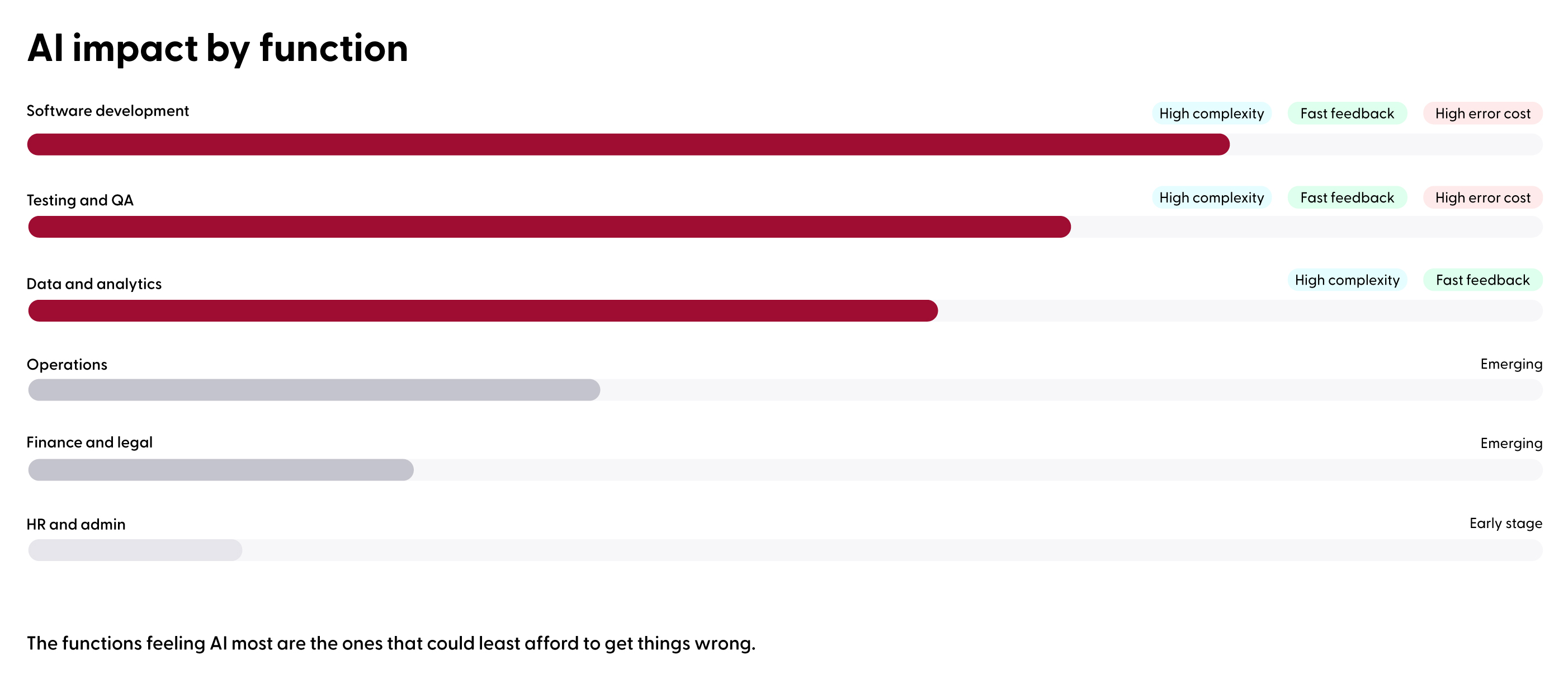
The impact of AI is not uniform across functions.
Software development, testing, quality assurance, and data roles report the highest gains. These are environments defined by complexity, rapid feedback loops, and high cost of error.
In these contexts, AI does not just accelerate work. It reshapes it.
Execution-heavy tasks are being replaced by design-led thinking, where professionals focus more on structuring problems and iterating solutions rather than manually producing outputs.
The shift is not without friction. Accuracy remains a concern, particularly in high-stakes scenarios. Outputs often require validation, which introduces additional steps into workflows. Data security and privacy considerations also influence how and where AI tools are used.
These are not barriers to adoption. They are operational constraints that need to be addressed.
One employee captures this balance well: “AI has taken away a large portion of my manual tasks and made research much more efficient. While there are some reliability concerns, having secondary sources for validation helps.”
That is the right posture, not enthusiasm or resistance, but a clear recognition that the tools are genuinely powerful but also genuinely imperfect.
The challenge is no longer convincing teams to use AI. It is enabling them to use it effectively and responsibly within defined guardrails.
One of the most notable shifts is how capability is developing.
A majority of respondents report learning and experimenting with AI independently, outside formal training programs. Skills are being built through usage, iteration, and real-world application.
This kind of organic capability building is hard to manufacture and even harder to replicate.
It compounds over time and becomes the difference between organizations that experiment with AI and those that operationalize it.
AI adoption is no longer the primary challenge. Most organizations have already crossed that threshold.
The focus is shifting to execution:
Organizations that treat these as secondary concerns will struggle to realize the full value of AI, even with high adoption levels.
Nearly 70% of respondents expect AI to drive significant transformation in how work is done. Very few view this as temporary.
This level of alignment suggests that the shift is structural. The questions ahead are not about adoption. They are about governance, trust, capability development, and the systems required to support sustained use.
These are more complex challenges, but they are also the ones that matter.
Something fundamental has already shifted. It did not arrive as a headline moment, but in small, everyday changes: a draft completed before the coffee or a debugging session resolved before the next meeting.
Individually, these feel like conveniences. Collectively, they are redefining what a productive day looks like.
The floor has moved. The only question is whether you moved with it.
This article is based on internal survey insights across engineering, QA, and business teams at VRIZE.
