
Carbon as a constraint: Embedding sustainability into real-time supply chain decisions

A procurement team selects a supplier based on price and lead time. In that moment, thousands of tonnes of avoidable emissions are quietly locked in for years, unseen and unchallenged. Not because the data does not exist, but because it is not part of the decision. The companies that will lead the next decade will not just report carbon better but will learn to decide with it.
For most businesses, sustainability strategy and supply chain strategy are two separate conversations happening in two separate rooms. One produces targets and disclosures, while the other produces purchase orders and vendor contracts. The gap between them is where most of the carbon reduction potential of an organization quietly disappears, and this gap also highlights the evolving ESG role in modern supply chains, where alignment between strategy and execution determines real outcomes.
Supply chains are responsible for up to 80% of a company's total greenhouse gas emissions. That is not just a sustainability statistic, but an operational one. It implies that the decisions that determine a company's actual environmental impact are being made every day by procurement teams, logistics managers, and supplier relationship owners, most of whom have never seen a carbon figure in their workflow.
That is the problem worth solving.
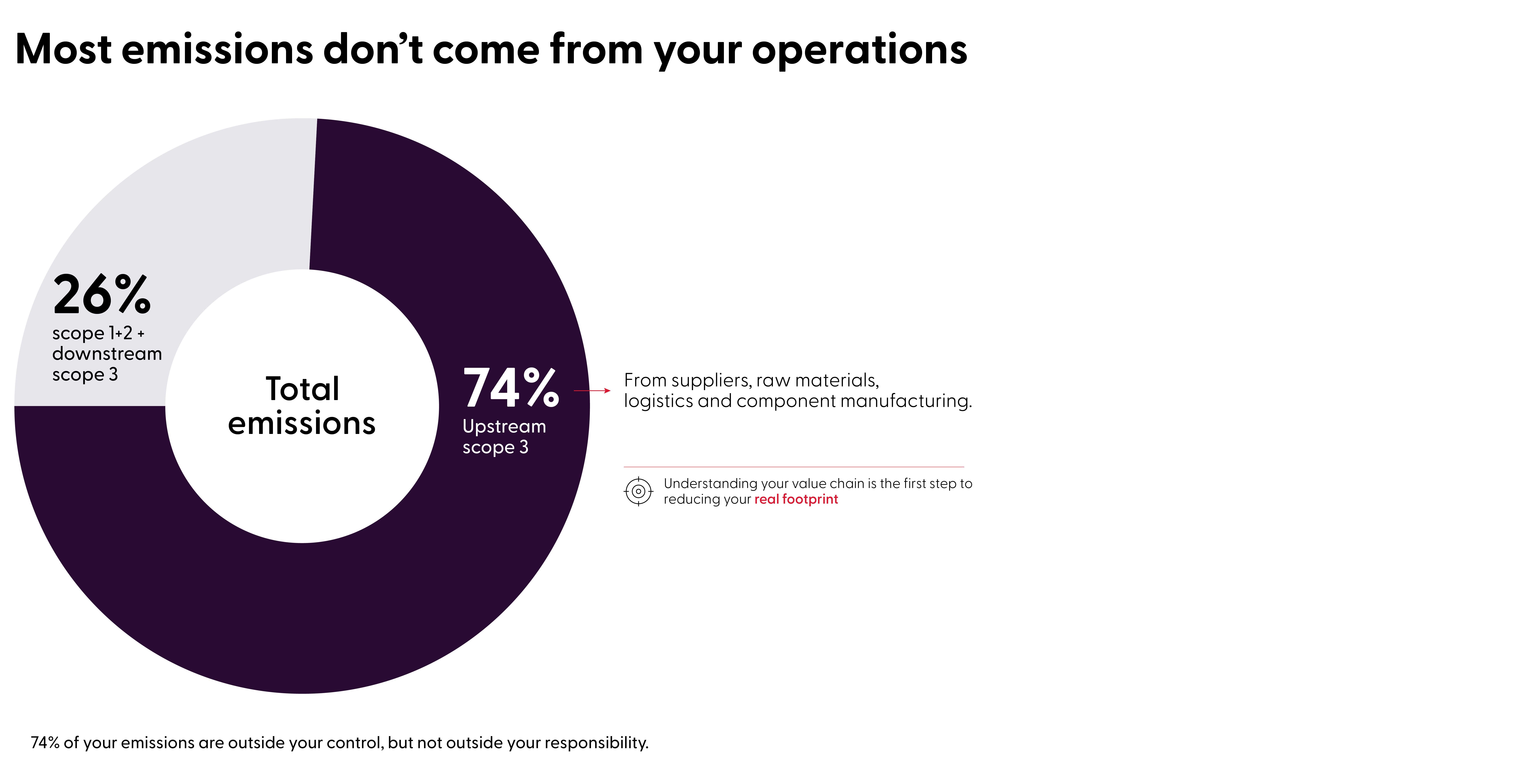
Scope 1 and Scope 2 emissions are direct and relatively accountable. But the real weight sits in Scope 3, the upstream and downstream emissions that occur across the value chain outside the organization's direct control. Scope 3 alone accounts for an average of 74% of an industry's carbon footprint. Supplier manufacturing, raw material extraction, inbound logistics, and component production collectively dwarf what happens inside a company's own facilities.
This is where most carbon emission reduction in supply chain efforts stall. Supplier data is inconsistent, visibility drops sharply beyond Tier 1, and the tools most procurement teams use were never built to surface carbon at the moment a sourcing decision is made. Building that visibility requires breaking down fragmented enterprise data silos, an architectural challenge we explore further in our article: The rise of Data Mesh: Breaking Silos for enterprise-scale analytics.
Scope 3 is not a measurement challenge waiting on better technology, it is an organizational design challenge waiting for clearer priorities.
The instinct most organizations follow is to issue requirements, carbon disclosures, sustainability commitments, and ESG thresholds. This produces paperwork that rarely changes.
Drawing from our past engagements, we’ve observed that the suppliers with the largest emissions impact are often the ones least equipped to respond. Mid-tier manufacturers, regional logistics providers, and specialized component producers operate on thin margins with limited sustainability infrastructure. A compliance framework handed down from a large buyer does not reduce emissions. It creates friction.
We’ve also noted that our partners, who have seen significant results, take a different approach. They treat supplier capability building as a core function and focus on the few suppliers where emissions, cost, and volume justify investment. Instead of pushing the entire base, they provide targeted tools, benchmarks, and incentives that create shared value. It takes longer than issuing a policy, but it works.
Every supply chain decision produces an emissions outcome, whether or not that outcome was considered. The case for real-time carbon data is not about visibility alone but about restoring the full cost of a decision to the moment it is being made.
IoT-enabled supply networks, AI-driven procurement platforms, and integrated analytics tools now make it technically feasible to surface carbon intensity at the point of purchase. What breaks this in practice is not technology, but the gap between having the data and building the organizational discipline to act on it. Closing that gap is an execution challenge, and one that most enterprises consistently underestimate.
At VRIZE, we increasingly see organizations struggle not with collecting sustainability data, but with operationalizing it across fragmented procurement, supplier, and logistics ecosystems. The challenge is no longer visibility alone. It is building decision systems where carbon intelligence can influence actions in real time.
Regulatory frameworks are tightening globally, and carbon will increasingly sit alongside cost and risk in enterprise supply chain decisions. Organizations with mature data, supplier engagement models, and embedded decision criteria will adapt with minimal disruption, but those who treated carbon as a mere communications exercise will find that the required infrastructure cannot be built quickly.
The most prepared enterprises are built for operations, not compliance. This distinction reinforces the ESG role in modern supply chains as an operational discipline rather than a reporting function. Science-based targets carry credibility with investors and regulators, but a target remains a number until it shapes decisions. The organizations making real progress embed sustainability into procurement criteria, supplier scorecards, logistics policies, and capital allocation, held accountable by the same teams whose daily choices determine the outcome.
Setting a science-based target without redesigning the decision workflows that determine whether you hit it is not a sustainability strategy. It is a disclosure strategy.
When sustainability is treated as an operational discipline, it reveals inefficiencies that cost-reduction programs overlook, fosters supplier relationships that are more durable than transactional ones, and establishes data infrastructure that enhances decision-making across functions.
The real advantage lies in the compounding effect. Teams that have spent years learning to use carbon data in procurement will operate at a fundamentally different level than those just starting when the regulatory deadline arrives. Supplier relationships built on shared sustainability infrastructure will absorb the next compliance wave with significantly less friction.
The window to build ahead of the requirement rather than in response to it is narrowing, not because the technology is inaccessible, but because the organizations that started earlier are compounding their advantage.
Enterprises that embed sustainability into operational decision-making today will be significantly better positioned to adapt to future regulatory, supplier, and market pressures.
Carbon was never just a reporting problem, but always an operational one. And by the time compliance becomes mandatory, the advantage will already be set. The difference will not be intent. It will be infrastructure.
