
The rise of Data Mesh: Breaking silos for enterprise-scale analytics

As organizations generate and consume data at unprecedented scale, traditional centralized analytics models are struggling to keep pace. Data bottlenecks, delayed insights, and overloaded central teams have become common challenges, limiting the business value organizations can extract from their data. In response, data mesh has emerged as a new architectural and operating paradigm, one that rethinks how data is owned, governed, and delivered across the enterprise.
Rather than treating data as a centralized asset managed by a single team, Data Mesh promotes decentralized ownership aligned to business domains. This shift reflects a broader move toward federated, product-oriented models that prioritize scalability, agility, and accountability in enterprise analytics.
Early enterprise analytics relied on centralized data warehouses, where data from across the organization was consolidated and curated by specialist teams. While effective in stable environments, these models struggled as data volumes grew and business needs diversified.
Data lakes promised greater flexibility, but in many cases introduced new governance and ownership challenges. Without clear ownership and governance, they often devolved into fragmented, low-trust repositories that were difficult to scale and maintain. Data Mesh architecture emerged in response to these limitations, reframing data as a product and embedding accountability within the business domains that understand it best.
Data mesh is defined by four foundational principles that collectively enable scale:

Business domains own and manage their data as products, taking responsibility for quality, availability, and evolution.
Data is designed, documented, and delivered with the same rigor as customer-facing products, ensuring usability and reliability.
Platform teams provide standardized tools that enable domains to publish and consume data independently.
Governance is enforced through shared standards and automation, balancing autonomy with enterprise-wide consistency.
When implemented effectively, Data Mesh reduces dependency on centralized teams, accelerates time to insight, and improves data quality through domain expertise. Self-serve platforms lower friction for analytics and AI initiatives, while federated governance maintains trust at scale.
Together, these benefits enable faster decision-making, greater resilience, and improved alignment between data and business outcomes.
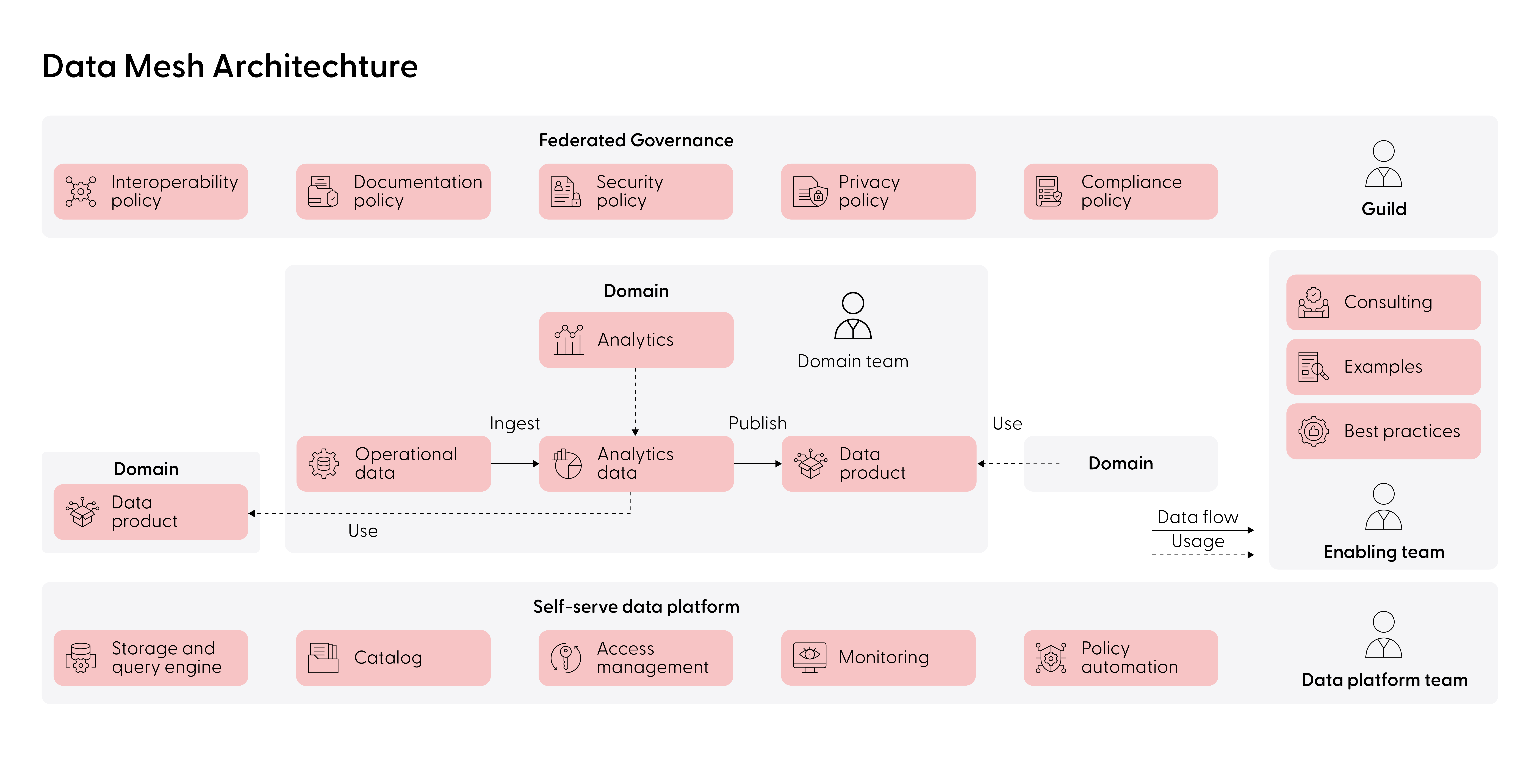
Implementing Data Mesh architecture requires far more than technical change. Success depends on aligning technology, operating models, and culture.
A robust self-serve data platform provides common capabilities for ingestion, transformation, discovery, and access.
Teams must be empowered to own data products, supported by clear roles, incentives, and collaboration models.
Strong leadership defines shared standards and accountability while avoiding re-centralization.
Scaling Data Mesh architecture introduces cultural, operational, and governance challenges. Organizations accustomed to centralized ownership often face resistance as responsibilities shift to domain teams. Skill gaps in data engineering, modeling, and quality management can slow adoption without targeted training and enablement.
Poorly designed self-serve platforms can create confusion instead of empowerment, underscoring the importance of discoverability through strong data catalogs, metadata standards, and intuitive interfaces. Balancing autonomy with oversight is equally critical. Without clear data contracts and federated governance, inconsistent standards can reintroduce silos.
Incremental adoption, starting with MVPs and expanding gradually, helps organizations manage risk, build confidence, and establish sustainable momentum.
Several organizations have already embraced Data Mesh architecture, adapting the model to their business and operating contexts. Their experiences highlight how decentralized ownership can transform analytics.
JPMorgan Chase adopted a domain-centric approach that enabled business units to manage their own data products while adhering to enterprise-wide governance standards. Intuit focused on empowering data practitioners through decentralized ownership and intuitive self-serve platforms, improving agility, data quality, and innovation by reducing reliance on centralized teams.
Across these examples, several clear patterns emerge. Decentralized ownership enables faster, more accountable decision-making, while federated governance maintains consistency without constraining flexibility. Businesses that adopt Organizational Data Mesh incrementally tend to achieve more sustainable outcomes than those pursuing large-scale change upfront.
These themes align closely with patterns explored in our work on automation maturity, where distributed ownership, clear contracts, and well-defined platform boundaries help teams move faster without losing alignment. Read more here.
The rise of Organizational Data Mesh signals more than just another architectural evolution; it represents a fundamental rethinking of how modern enterprises unlock value. The journey from tightly controlled data warehouses to flexible, experimental data lakes, and now to decentralized, domain-driven ecosystems mirror the shift in how modern organizations operate today: faster, federated, and deeply interconnected.
Data Mesh meets this moment by bringing ownership closer to the teams that understand it best, enabling faster insights, higher data quality, and greater alignment with business outcomes. However, as our experience consistently shows, success requires far more than adopting new architecture alone. It demands cultural readiness, strong governance and a thoughtful balance between autonomy and oversight. At VRIZE, we believe the true power of Data Mesh lies in operationalizing it with intention, starting small, building iterative value, and strengthening maturity of one domain at a time. Our work with organizations across industries reinforces that while tooling and platforms matter, the real differentiators are the people, processes, and product mindset behind them.
For organizations looking to modernize their data strategy, Data Mesh is not the destination, but a strategic launchpad, a model that, when executed with intent, empowers teams, accelerates innovation, and lays the foundation for sustained, enterprise-scale analytics.
