
From SBOMs to enforcement: Closing the trust gap in software pipelines

Organizations run vulnerability scanners, meet compliance requirements, and still ship software they cannot fully account for. The problem is not the tools. It is the assumption that documentation equals control.
Security pipelines are active, yet breaches tied to third-party dependencies and unverified build artifacts continue to grow. The gap is structural. Organizations have not aligned on what trust means, where it begins, or how it is enforced. In the same way AI reveals organizational capability rather than creating it, a software bill of materials does not create security. It reveals whether an organization truly understands what it is shipping.
A software bill of materials (SBOM) is a structured, machine-readable inventory of every component in a software artifact: open-source libraries, commercial dependencies, build tools, and the relationships between them. It answers a fundamental question: what exactly is in the software being prepared for production?

Most organizations treat SBOM generation as a compliance exercise. The file is generated, attached to the release, and then ignored. SBOM creates value only when it is connected to three things: a vulnerability database that is continuously updated, a policy engine that acts on what it reveals, and an enforcement mechanism that stops non-compliant software from progressing.
Without those connections, an SBOM is documentation, but with them, it becomes active control.
An SBOM becomes actionable only when it is embedded into the delivery pipeline as a control mechanism:
In this model, every build is evaluated in real-time. Non-compliant artifacts are blocked before they progress. Trust is not verified at the end. It is enforced at every stage.
“Trust is not verified at the end. It is enforced at every stage.”
Shift-left security, as a principle, tells us to move security checks as early in the development lifecycle as possible, but the real insight behind that principle is about trust: every stage of the pipeline should only receive artifacts that have been verified by the stage before it.
In practice, this means:
Each transition becomes a trust decision.
Organizations that rely on a final checkpoint are not operating secure pipelines because by the time issues surface at the end, remediation costs are higher, releases are delayed, and exceptions become more likely under pressure.
Continuous testing operationalizes this model. In our engagements, we have embedded SBOM validation, continuously updated vulnerability intelligence, and policy checks directly into CI/CD pipelines. This ensures every build is evaluated in real-time against risk and compliance criteria, enabling teams to flag or block non-compliant components early and avoid last minute disruption before release.
Most enterprises have security policies, but fewer have those that are automatically enforced. This gap is where most supply chain risk concentrates.
Effective policy enforcement in a DevSecOps CI/CD pipeline means translating written policies into executable rules that run automatically at every build. A policy that says no component with a critical CVE may reach production is only as strong as the pipeline gate that checks every component against the SBOM and blocks the build when that condition is met. As Agentic AI and the new security mandate makes clear, organizations redesigning trust and governance for modern threats are finding that enforcement has to be structural, not procedural.
Risk-based prioritization is essential. Critical vulnerability in an authentication library is categorically different from a medium-severity issue in a logging utility. Policy engines need to reflect those differences, escalating without generating enough noise to trigger tool fatigue, and when developers disengage from security tooling due to excessive false positives, the enforcement loop breaks quietly and completely.
The urgency around software supply chain security is increasing:
In this environment, visibility alone is not enough. Enforcement becomes the differentiator.
Incidents like SolarWinds and Log4j illustrated the same uncomfortable truth that an organization is responsible for the security of software it did not write. The attack surface is every dependency the code touches, every tool in the build environment, and every third-party service the application calls.
SBOM practices cannot remain internal. Procurement decisions must account for SBOM availability, and vendors that cannot provide a machine-readable inventory introduce unquantifiable risk. The same principle underpins Zero trust in healthcare: never assume trust based on origin but always verify based on evidence.
Regulatory directions are also reinforcing this shift. Executive orders, NIST guidance, and the EU Cyber Resilience Act are moving toward mandatory SBOM requirements. Organizations that are building these capabilities today are not only reducing exposure but positioning themselves ahead of regulatory and market expectations.
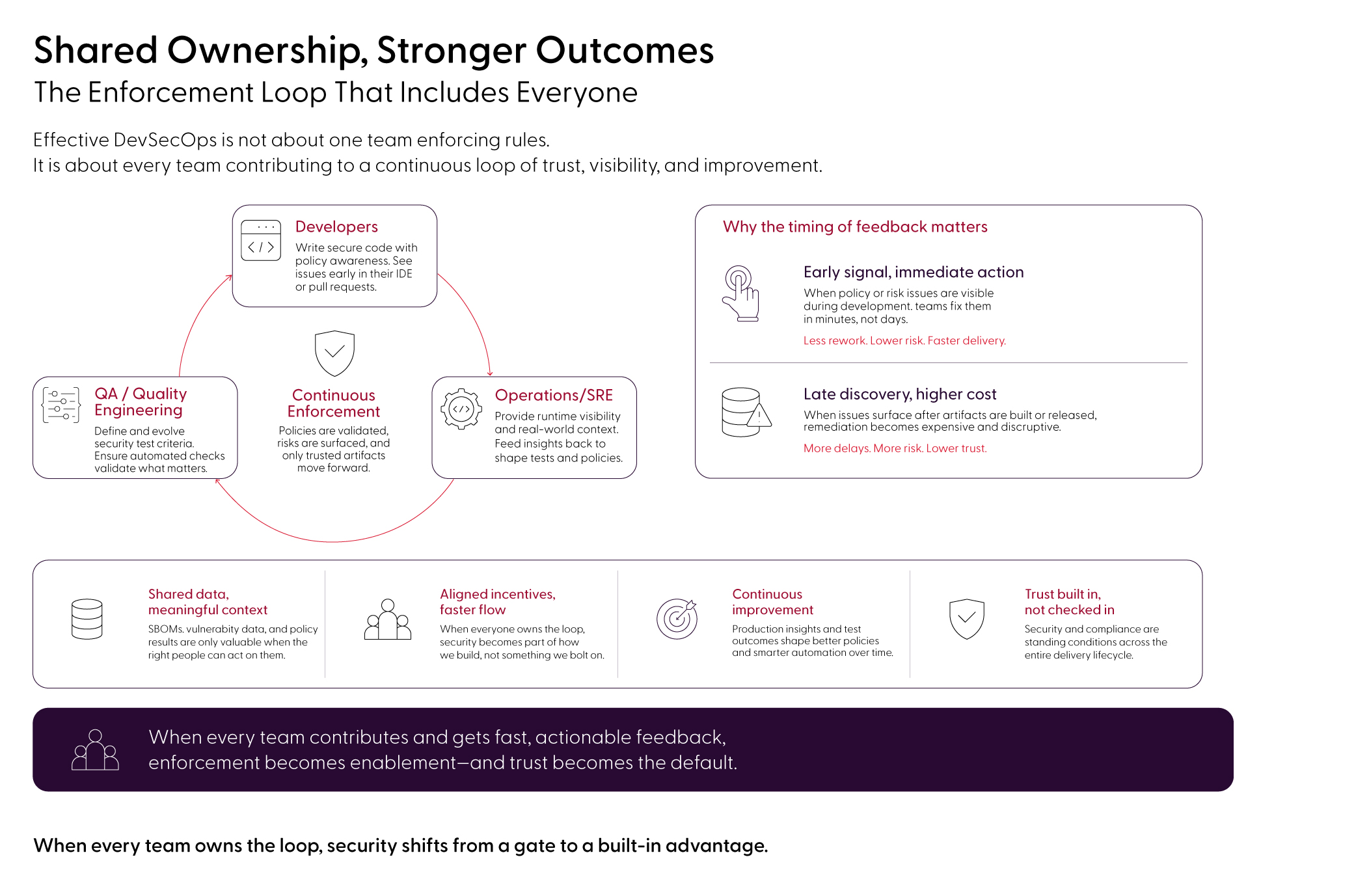
In organizations running mature DevSecOps CI/CD pipelines, trust and policy enforcement are shared responsibilities and not merely security concerns. Developers understand why the policies exist, QA engineers help define acceptance criteria for security tests, and Operations teams provide production visibility that feeds back into testing priorities.
SBOM and policy enforcement generate data that becomes actionable only when it reaches the right person at the right time. A developer who sees a violation in a pull request resolves it immediately. The same issue discovered after packaging creates delay, friction, and risk. Resistance to DevSecOps often stems from the perception that security slows delivery, but that perception changes when feedback loops are fast, precise, and contextual.
Most security failures in the software supply chain are not tool failures but are ‘clarity’ failures. The ones that have gotten this right share one thing in common: they stopped treating trust as something assumed at each pipeline stage and started treating it as something that has to be earned and verified at every handoff.
That shift does not come from a better scanner or a newer policy engine but from an organizational decision that ambiguity about what is in the software is no longer acceptable, followed by building the practices, accountability structures, and enforcement mechanisms that sustain that standard. Every component either has a verified identity or it does not. Every build either passed policy checks or it did not. Every deployment either came from a verified, signed artifact or it did not.
Mature software delivery is defined by this clarity. Trust is not a claim or a checkpoint. It is a continuously verified condition, built into the pipeline and enforced by design.
