
Identity and access management for Agentic AI: Closing the security gaps

As autonomous AI agents gain access to enterprise systems, organizations must rethink how they manage delegated authority, enforce least privilege, and maintain accountability across agent workflows
Enterprise identity and access management (IAM) has evolved around three fundamental questions: who is requesting access, what are they permitted to do, and under what conditions should that access continue? Multi-factor authentication, conditional access, and periodic access reviews help organizations answer these questions for human users and traditional workloads.
But agentic systems ask for something else, and the gap is clearest when someone leaves. An analyst authorizes an agent to pull reports from a data platform every week, and within a month nobody remembers the arrangement.
When the analyst leaves, the organization disables the account, revokes active sessions, and removes associated permissions. Yet the agent may continue operating if it holds an independently issued credential that is not linked to the analyst's identity lifecycle. The employee's access has been removed, but the agent's permissions remain active. The employee offboarding process worked as designed, but the agent’s independently managed access remained outside its reach.
The challenge is not simply identifying an agent or determining what permissions it holds. Enterprises must also establish whose authority the agent is exercising, how that authority has been delegated, and whether it remains valid. This becomes increasingly complex when agents operate across systems or delegate tasks to other agents.
Traditional IAM supports several forms of delegated access, but many implementations are not designed to govern the dynamic authorization patterns introduced by autonomous agents. Unlike conventional service-account workloads that typically operate within predefined permissions, AI agents may select actions at runtime, act on behalf of users or systems, and delegate tasks to other agents. These capabilities introduce additional challenges for identity governance, authorization, and accountability.
One important architectural decision is how an agent receives and exercises access. A straightforward but risky approach is to give the agent the user's access token directly. Downstream systems may then see requests as originating from the user, making it difficult to distinguish the agent's actions from those of the person who authorized it.
A more transparent approach preserves both identities: the user whose authority is being exercised and the agent acting on their behalf. OAuth RFC 8693 provides a framework for token exchange that can represent this distinction. When supported by the authorization infrastructure, this approach allows systems to preserve both identities while issuing short-lived, narrowly scoped credentials. However, recording these identities does not automatically guarantee that delegated permissions are correctly enforced.
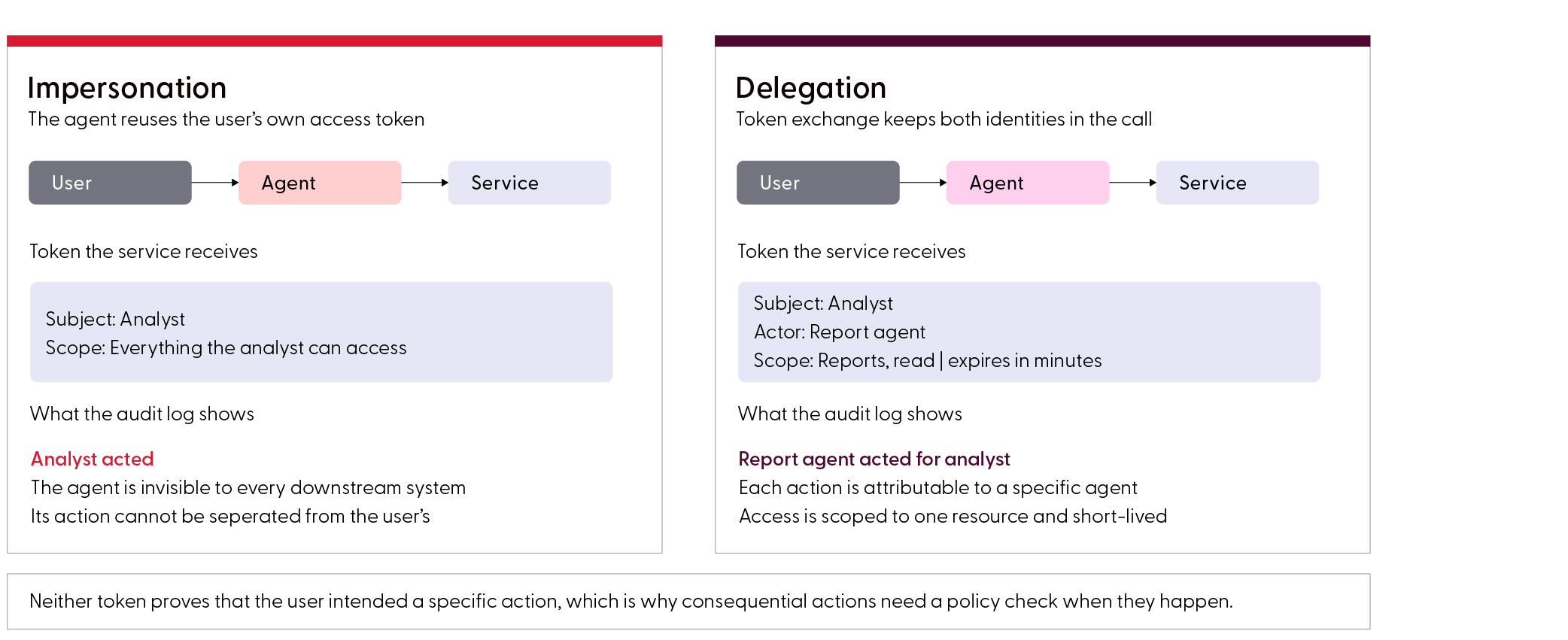
Impersonation can obscure the agent’s identity, while properly implemented delegation preserves both identities and enables more accurate attribution of agent actions.
However, even that proves less than it appears, because a delegation token shows that an agent received authority from a user, but not that the user intended this action.
A delegation chain involving a user, an agent, and a downstream service may be relatively straightforward to represent. Complexity increases when agents delegate tasks to other agents, creating multiple layers of authority. At each step, the authorization system must determine whether the next agent is permitted to act and whether its permissions remain within the original grant.
OAuthRFC 8693 can represent delegation relationships through actor claims, but these claims do not automatically enforce limits on downstream permissions. Emerging IETF work on agent delegation addresses this distinction between recording authority and constraining how it can be exercised. Enterprises therefore need authorization controls that validate the permissions granted at each step of a multi-agent workflow.
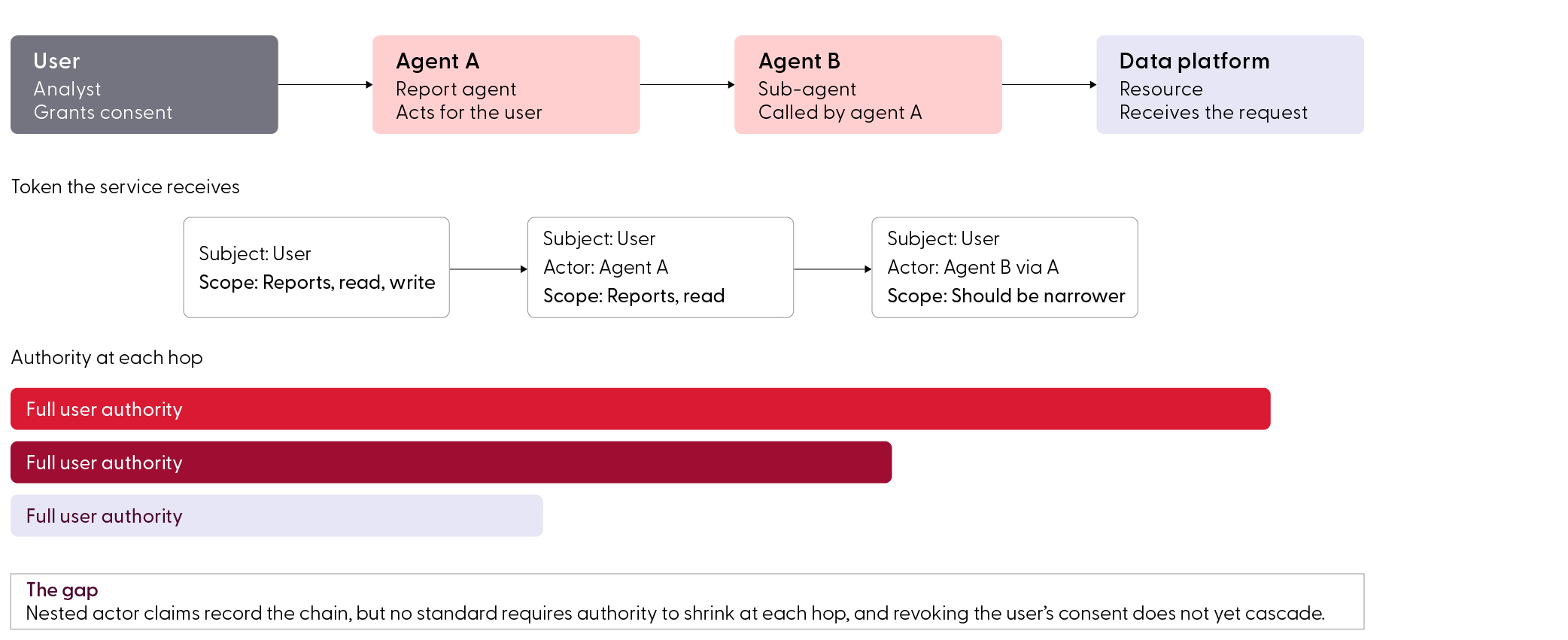
Each delegation hop should receive only the authority it requires, but recording a delegation chain does not guarantee that these limits are enforced.
Software supply chains have a similar gap, where an attestation never checked at deployment gives assurance only on paper, as we’ve discussed in from SBOMs to enforcement: closing the trust gap in software pipelines. Delegation chains are in the same position, recorded properly but enforced unevenly.
Human identity governance runs on events such as hire, transfer, or departure, while periodic certification assumes a human such as a manager who can vouch and roles that change gradually with time.
Autonomous agents do not always fit traditional identity lifecycle models. They may be created dynamically, operate across multiple systems, or continue running independently of the user who initiated them. Without explicit ownership, registration, and lifecycle controls, organizations can struggle to determine who is accountable for an agent's access and when that access should expire.
Revocation becomes particularly important in multi-agent environments. Although existing identity platforms support token and credential revocation, ensuring that withdrawn authority is consistently enforced across every downstream agent, service, and delegated credential requires additional coordination and controls. Without these safeguards, an agent may retain access beyond the original authorization, the departure of the person who granted it, or the completion of the task it was intended to perform.
The standards bodies have started to respond. OWASP ranks agent identity and privilege abuse third in its first Top10 for agentic applications. NIST has proposed giving agents their own identities in enterprise systems, and several IETF drafts cover delegation to agents. Additionally, major identity platforms are also adding dedicated agent identities with separate audit logs.
While standards and identity platforms continue to evolve, enterprises cannot rely on emerging specifications alone. Organizations deploying autonomous agents need enforceable authorization policies, runtime access checks, and mechanisms to revoke delegated permissions. These controls should be integrated into the systems and services agents access, ensuring that authorization is evaluated when actions are performed.
The analyst’s case shows where the gap lies. Offboarding worked as designed, yet three things were missing: a record tying the agent to an accountable person, an expiry that would have forced a deliberate renewal, and a revocation path that reached everything built on it.
For enterprises deploying autonomous agents, these gaps translate into four essential controls: assign every agent an accountable owner, enforce least-privilege permissions across delegation chains, apply explicit expiration and renewal policies, and establish revocation mechanisms that reach downstream credentials and services. These controls should be supported by monitoring and audit records that show how authority was granted and exercised.
These checks govern what an agent is allowed to do, which comes before proving what it actually did. An execution trace can show what happened, but not whether the authority behind it was ever properly held.
Unlike an employee, an agent holds borrowed authority, and borrowed authority has to be returnable.
