
The architecture of trust in multimodal AI

As enterprise AI begins combining text, images, audio, and video, security shifts from protecting individual models to protecting the interactions between them.
For the past few years, the story of enterprise AI was a story of capability. Models that could read a contract, then a chart, then a photograph, then a voice note, and tie them into a single answer. That convergence is real and useful, but it is also the reason the security conversation has shifted underneath most organizations without their noticing. The vulnerabilities are not implementation flaws. They're an architectural consequence of multimodal AI itself.
A single-modality model has one way in, whereas a multimodal system has several. Each modality carries its own failure modes into a “shared brain” that was trained to trust all of them at once. Text can be injected, images can be distorted, and audio can be spoofed. Once the model fuses those signals, a weakness in any one of them becomes a weakness in all. Each modality added is a new entry point, and the safeguards most teams rely on were built when there was only one door to defend.
Data leakage is the quiet, structural vulnerability in multimodal systems, and it shows up in more than one place:
None of these requires a dramatic exploit. They are the cost of connecting a powerful model to sensitive data without deciding what it is allowed to remember and what it is allowed to reveal.
The more deliberate threat is poisoning, and it is harder to catch because it happens upstream. AI model poisoning manipulates the model or its training process to cause it to behave in the way that an attacker desires. Sometimes the goal is broad, degrading accuracy across the board with misleading data until the outputs cannot be trusted, while sometimes it is more precise, bending behavior only for specific inputs, while the model performs normally everywhere else.
Because poisoning happens before deployment, conventional runtime monitoring often fails to detect it.
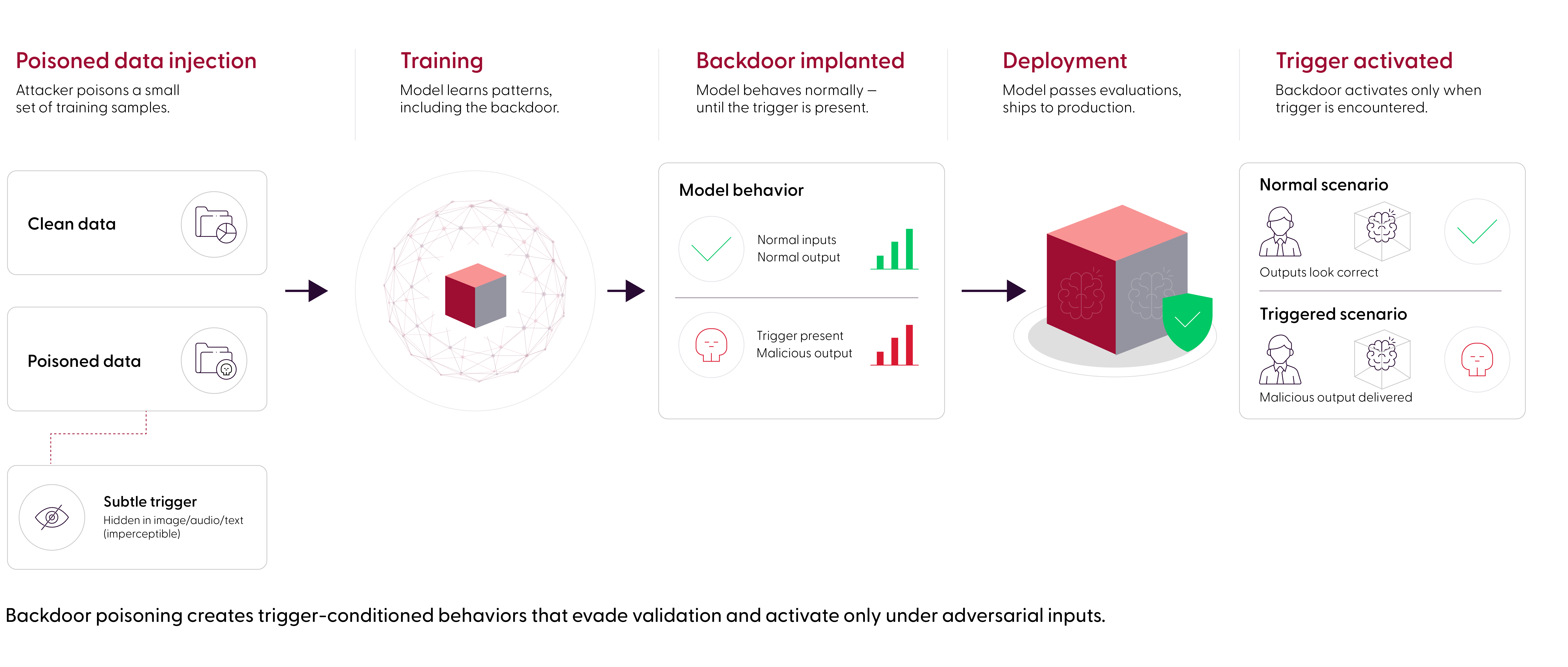
The version to be worried about is the ‘backdoor’. A subtle trigger can be planted in a small set of training samples, and the model quietly learns to misbehave only when that trigger turns up. On every ordinary input, it looks healthy, passes evaluation, ships, and waits. This is what makes AI model poisoning so dangerous in a multimodal setting because the poisoned trigger can be hidden in an image or audio sample rather than plain text. A model can be compromised long before it ships, without a single person touching it at runtime.
Adversarial attacks take the other route and exploit the model in the moment. The most familiar of them today is prompt injection, where malicious instructions are smuggled into the input. Sometimes they arrive directly, written in a user message, but sometimes, and more dangerously, they arrive indirectly, planted in a document, a webpage, or an API response that the model reads as part of its work. The system was initially told to be helpful, and the attacker simply supplies the instructions.
In a multimodal setting, this gets worse because the instruction no longer has to be text. It can ride inside an image or a file the model has been trained to interpret, slipping past filters that were only ever built to read words.
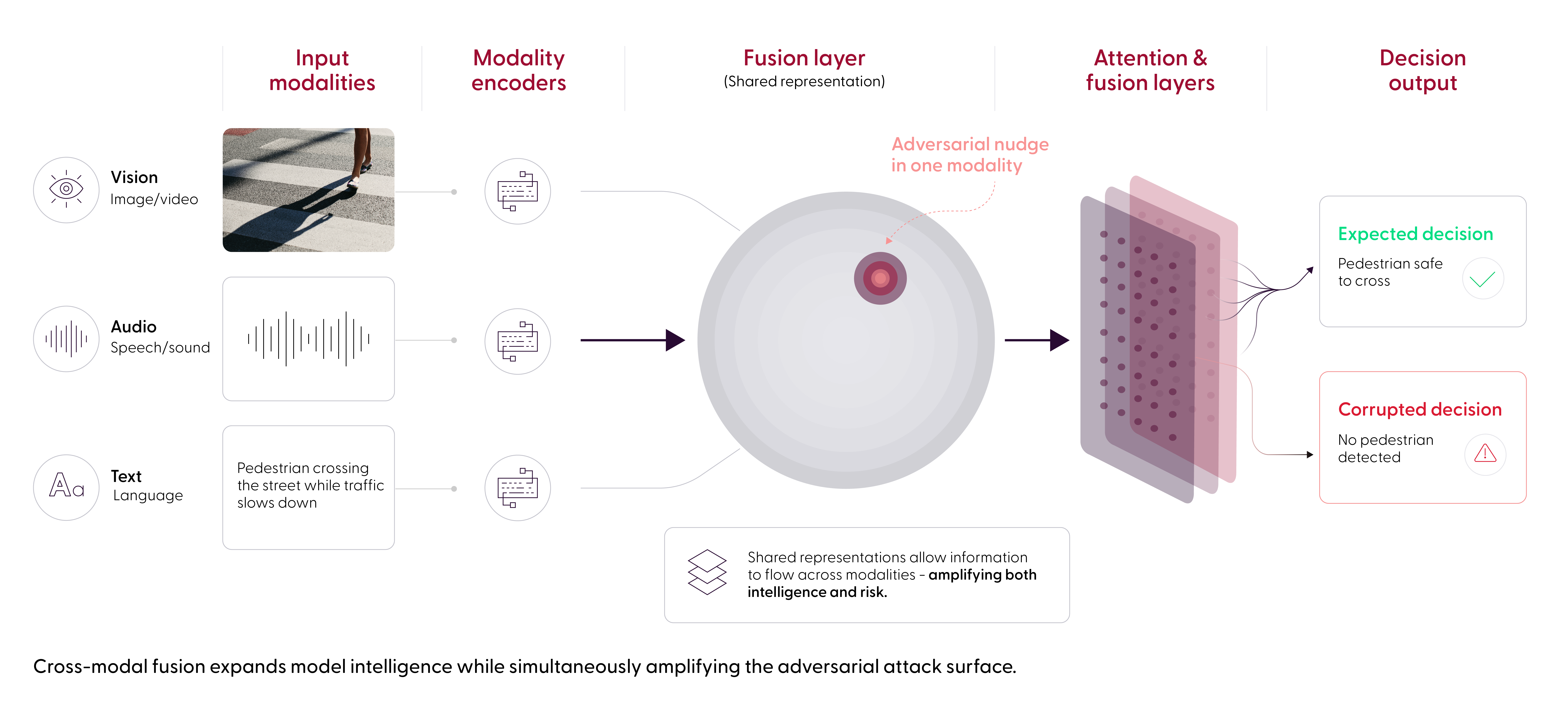
The common thread running through all of this is fusion. Multimodal models work by building shared representations across data types, and that shared space is exactly what makes them powerful and exactly what makes them fragile. An adversarial nudge in one modality can escalate through the fused representation and corrupt a decision that looked like it depended on something else entirely. The attention and fusion layers, often inherited from large, pre-trained components, become a place where small, well-placed manipulations turn into systematic errors. Most multimodal AI vulnerabilities do not live inside any one modality but in the seams between them.
Organizations rarely struggle because one modality fails in isolation. They struggle because the interaction between modalities creates security assumptions that no single team owns.
This situation is not hypothetical. In healthcare, tampered imaging paired with altered records can produce a confident misdiagnosis, with the patient bearing the consequence. In autonomous systems, manipulated sensor readings can mislead navigation in ways that end in a collision rather than an error log. On social platforms, coordinated text and image manipulation spreads misinformation that is difficult to trace and difficult to retract. And then there are also severe commercial implications. Breaches drive downtime, downtime drives churn, and personalized data in the wrong hands can turn a model into a targeting tool. When these consequences arrive, the conversation stops being purely technical and begins to raise the ethical risks of AI that we have analyzed separately.
Organizations rarely fail because they adopt AI too quickly. They fail because their security architecture evolves more slowly than the systems they deploy. Capability scales rapidly. Trust must be engineered deliberately.
No single tool fixes this, and any vendor who claims otherwise is worth treating with caution. The mistake we see most often is treating governance as a document produced once and filed. It is not paperwork but a live control plane, the place where ownership, data handling, and human oversight are either exercised continuously or not at all.
In practice, that starts with honesty about where the weak spots are, including the biases that creep in when training data and real-world input drift apart. From there it gets concrete. You decide who owns the system and what it is allowed to do, then standardize how data is handled and manage its full lifecycle so nothing fragments into an opening. Before the model reaches production, it needs to be trained against adversarial examples and have its inputs validated, so it has already seen manipulation, and privacy-preserving techniques should let the computation run without exposing the underlying data.
But none of it holds without people watching, because no fixed defense survives a threat that keeps changing. Governance earns its name only when a human stays in the loop on the decisions that matter. This is the same redesign of trust and authority that securing agentic AI systems now demands.
The honest position is that these vulnerabilities are not just a phase that technology will outgrow. They’re the standing cost of building systems that see, read, and listen at once, and that cost climbs every time these systems are trusted with more. So, the work ahead is not just a search for one perfect defense, but the harder, slower discipline of building AI whose decisions can be explained, whose data can be traced, and whose failures surface loudly instead of hiding inside a clean-looking output.
That is where we place our bet. The teams that scale multimodal AI safely treat security as the shape of the build, not a gate at the end of it. Capability was rarely the constraint. The harder thing is trusting a system on a live decision, under conditions no one rehearsed, and being right anyway.
That’s the bar now. As capability becomes commoditized, it stops setting anyone apart, and the organizations that will be ahead are the ones that can show their systems do exactly what they claim, then defend that claim when it is tested. That is also the sharpest question to ask of any partner.
Capability is becoming table stakes. Trust is becoming the competitive advantage.
