
Why AI is rewriting the economics of technical debt

AI didn't invent technical debt. It changed the economics of how fast it compounds and who ultimately pays for it.
A developer opens a pull request written largely by an AI assistant, scans it, runs the tests, and approves it. The feature works, the deadline is real, and somewhere in the back of their mind sits a question they do not have time to answer: do I actually understand what this code does, and could I change it safely in six months?
Most of the time, the honest answer is no, but the code ships anyway. That small, repeated moment is where much of today’s technical debt is created. The debt itself is not new; what changed is how fast it builds and how easily it can hide.
Technical debt used to be something one could momentarily defer, because it accumulated at human speed. A team could only write so much code in a week, and so could only create so many errors. But now, that ceiling has disappeared.
AI coding assistants let a small team produce volumes of code in a fraction of the time. The productivity gain is real and even worth having, but the same tools that let developers code quicker also let technical debt accumulate faster, turning shortcuts that once took months to emerge into problems by the very next sprint.
AI rarely creates new forms of technical debt. Instead, it accelerates the debt organizations already carry, turning long-standing architectural compromises into immediate delivery challenges.
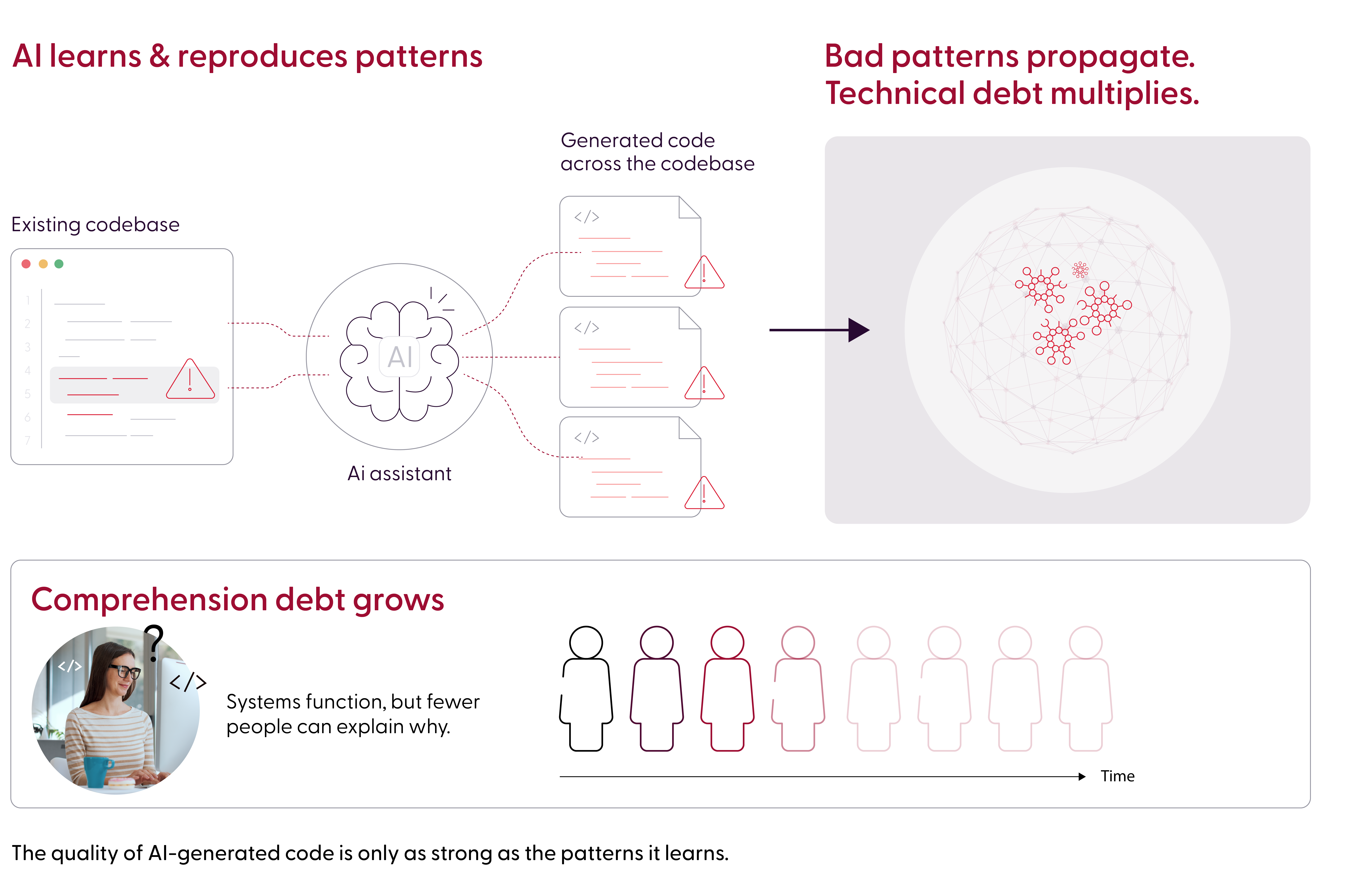
An AI assistant learns the patterns of the codebase it works in and reproduces them. If the existing code is clean, it extends clean patterns. If the code is tangled and inconsistent, the assistant reproduces the tangle because it has no way of distinguishing deliberate architectural decisions from compromises that were never meant to become permanent.
Bad patterns no longer remain contained, they propagate. A single questionable shortcut, once isolated to the file where someone wrote it, becomes a template the assistant copies across the system. This is what makes AI technical debt behave differently from the technical debt teams have traditionally managed.
Another quieter shift is who holds the understanding. When a human writes code, they carry a mental model of why it works, but when an assistant writes it, and a human approves it, that model is thinner. Multiply that across a team and, over time, organizations end up with systems that function but that fewer people can genuinely explain. Comprehension debt, which is the distance between what a system does and what its owners can account for, may be the most expensive form of all.
Code is only one layer. The models an organization deploys also run on data, and on the infrastructure that moves that data around, and both carry their own accumulated debt, which is mismatched schemas, duplicate records, and enterprise data silos where a field means one thing in one system and another elsewhere. None of it caused much trouble while humans were reading the output and quietly correcting it.
But AI removes that human correction. A model operating on inconsistent data does not pause to wonder whether two fields that should match actually do; it instead produces a confident answer built on a shaky foundation, and the flaw stays invisible right up until it becomes expensive. This is why AI technical debt is rarely confined to the codebase and reaches back into the data and the infrastructure underneath, where it is hardest to reach and slowest to fix.
The most common instinct is to count technical debt as a maintenance expense, a line for bug fixes and rework. That is certainly real, but it understates the problem, because the larger price is paid in speed. Teams weighed down by technical debt spend their days understanding and working around what already exists instead of building what comes next, and the gap between intention and delivery keeps widening.
In an era defined by how quickly an organization can adapt, that is the cost that matters most. Every shortcut is really a trade of technical debt vs business value, and the bill arrives as lost velocity long before it shows up in a maintenance budget.
The common solution when debt becomes painful is to schedule a cleanup, a quarter set aside to pay it all down at once. However, these efforts almost always stall because they treat debt as a one-time project rather than a permanent condition. The more durable approach keeps debt continuously visible and manages it within normal delivery: knowing where the debt actually lives, so choices about it are deliberate rather than accidental, and deciding which debt is worth carrying, because not all of it is worth repaying.
For the heaviest architectural and legacy debt, the kind that cannot simply be refactored away, the work is to retire it through incremental legacy modernization, without halting the business that runs on it.
Technical debt is increasingly being treated as what it has actually become: a governance question rather than an operational one. The choice to take on debt, carry it, or repay it is a choice about where an organization is willing to accept risk and where it is not, and that choice deserves the same visibility as cost or security.
The organizations that manage technical debt well make it difficult for debt to accumulate invisibly. When the cost of a shortcut is visible at the moment it is taken, teams weigh technical debt vs business value more honestly and make better decisions.
The encouraging part is that the same technology that creates debt at machine speed can also help find it. AI tools can now scan a codebase, surface fragile areas, flag inconsistencies, and even propose repairs. The capability is no longer the difficult part. What remains difficult is judgment: deciding what to keep and what to retire, which debt buys real speed, and which only feels like it, and when to slow down to stay ahead. A model cannot settle those questions, because they are about what the business values, not what the code does.
A developer approving a pull request they do not fully understand is not making a technical mistake. They are making a business decision about acceptable risk, usually without realizing it, and almost always without anyone having decided it was acceptable.
In the age of AI, the competitive advantage belongs to those that deliberately decide what technical debt they are willing to carry and what they refuse to inherit.
