
Why latency is the new competitive advantage in enterprise applications

In modern enterprises, speed is no longer just a performance metric but a defining part of the user experience. As expectations rise, enterprises that prioritize real-time responsiveness are setting the standard for customer engagement and trust.
Speed was once something enterprises optimized for after everything else was working. That framing is now obsolete. In an environment where digital interactions are the primary relationship between a business and its customers, latency is not a performance metric, but a design decision. Organizations that have not internalized that distinction are losing customers to those that already have.
Users almost never describe an application as slow. They simply leave. They abandon the cart, close the tab, switch to a competitor, and often cannot articulate why.
What is happening is psychological. A fast, responsive system does not just feel convenient but also feels reliable. It builds trust that accumulates across every interaction. A slow system does the opposite, creating friction that users register emotionally before they register it consciously. The frustration is real, even when the cause is invisible.
Latency is not just a performance metric, but a design decision. The organizations that have not yet internalized that distinction are losing customers to ones that already have.
This is why latency must be treated as a UX discipline, not purely an infrastructure one. The teams optimizing server response times and the designers shaping user journeys are working on the same problem, and this is precisely where enterprise application performance optimization becomes central to delivering meaningful digital experiences.
The word latency is often used loosely, and that creates real strategic confusion. In practice, it has three distinct components, each requiring different interventions.
Analysis latency is the time a system takes to interpret incoming data. Decision latency is the delay between analysis and action, while action latency measures execution delay. In enterprise environments, all three compound. A system that analyzes quickly but responds slowly still produces poor user experiences.
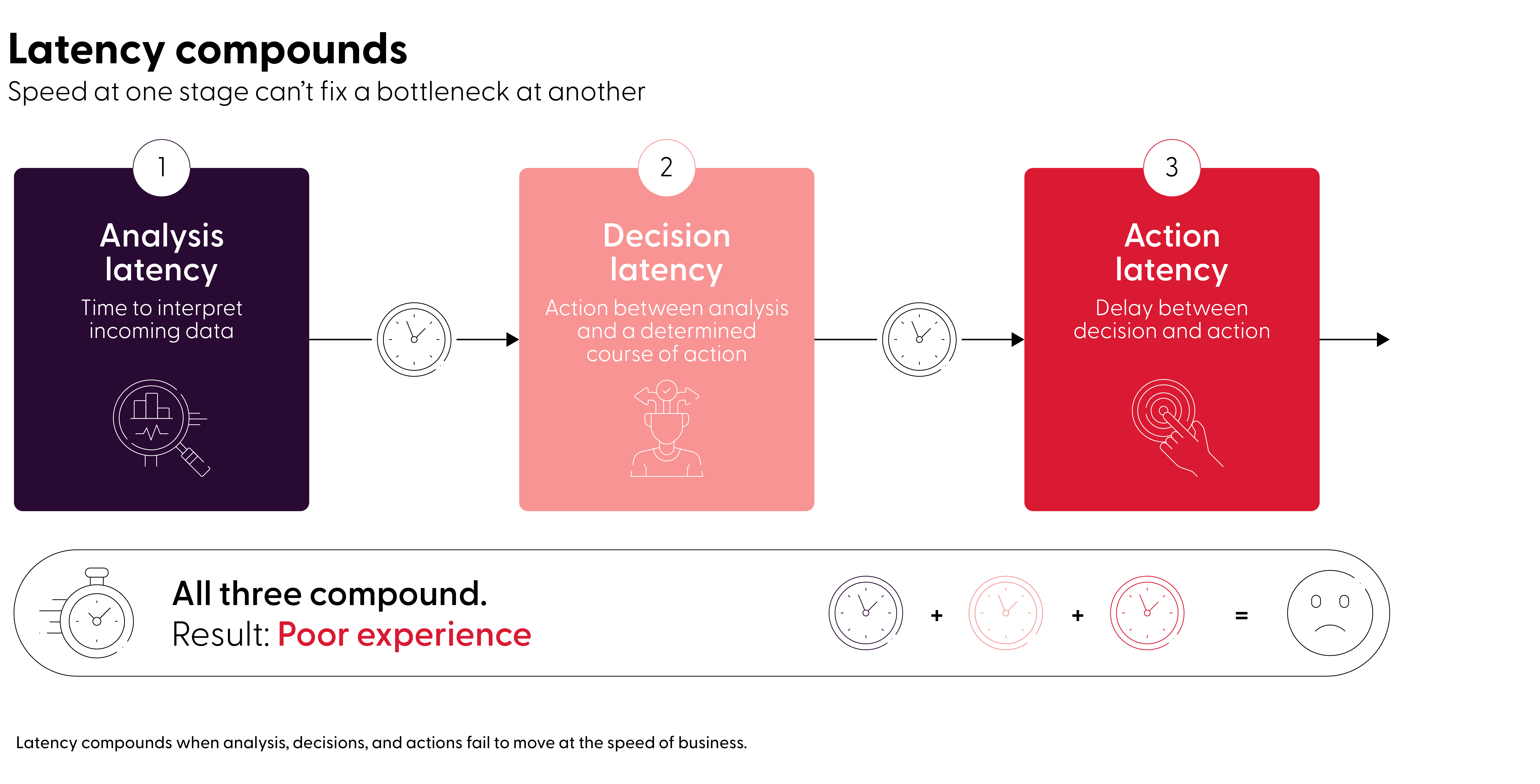
The organizations that manage latency well tend to think about it as a chain, where the weakest link sets the ceiling. Optimizing the most visible stage while ignoring upstream or downstream delays is a common trap, and it generally produces diminishing returns that are hard to diagnose because the improvements look real in isolation. This subtle shift toward scalable and responsive systems is also transforming how enterprises approach digital engineering, as explored further in our article The Digital Engineering Advantage: Driving Smarter Product Innovation.
Industries like finance, healthcare, e-commerce, and logistics invested in real-time systems early because the cost of delay was immediate and measurable. A slow trading platform can lose capital in seconds, while delays in healthcare monitoring can elevate clinical risk, or an e-commerce checkout that lags loses the transaction.
What has changed is that these expectations now apply universally. Users interact daily with fast, seamless digital products, and those experiences set their baseline for every business they engage with. Customers no longer benchmark experience only against competitors, but against the best digital interaction they have had anywhere.
Google's recommendation of keeping page load times under two seconds is grounded in clear behavioral data. Beyond that threshold, abandonment rates rise sharply. In voice and video applications, delays above 50 milliseconds degrade interaction quality before users consciously register the issue.
Real-time performance is no longer a competitive advantage, but the baseline. Enterprises are investing with greater intention in real-time data processing architecture to support experiences that feel immediate, reliable, and seamless. That’s why at VRIZE, we are continuously helping enterprises modernize infrastructure, optimize system responsiveness, and build architecture designed for real-time scale.
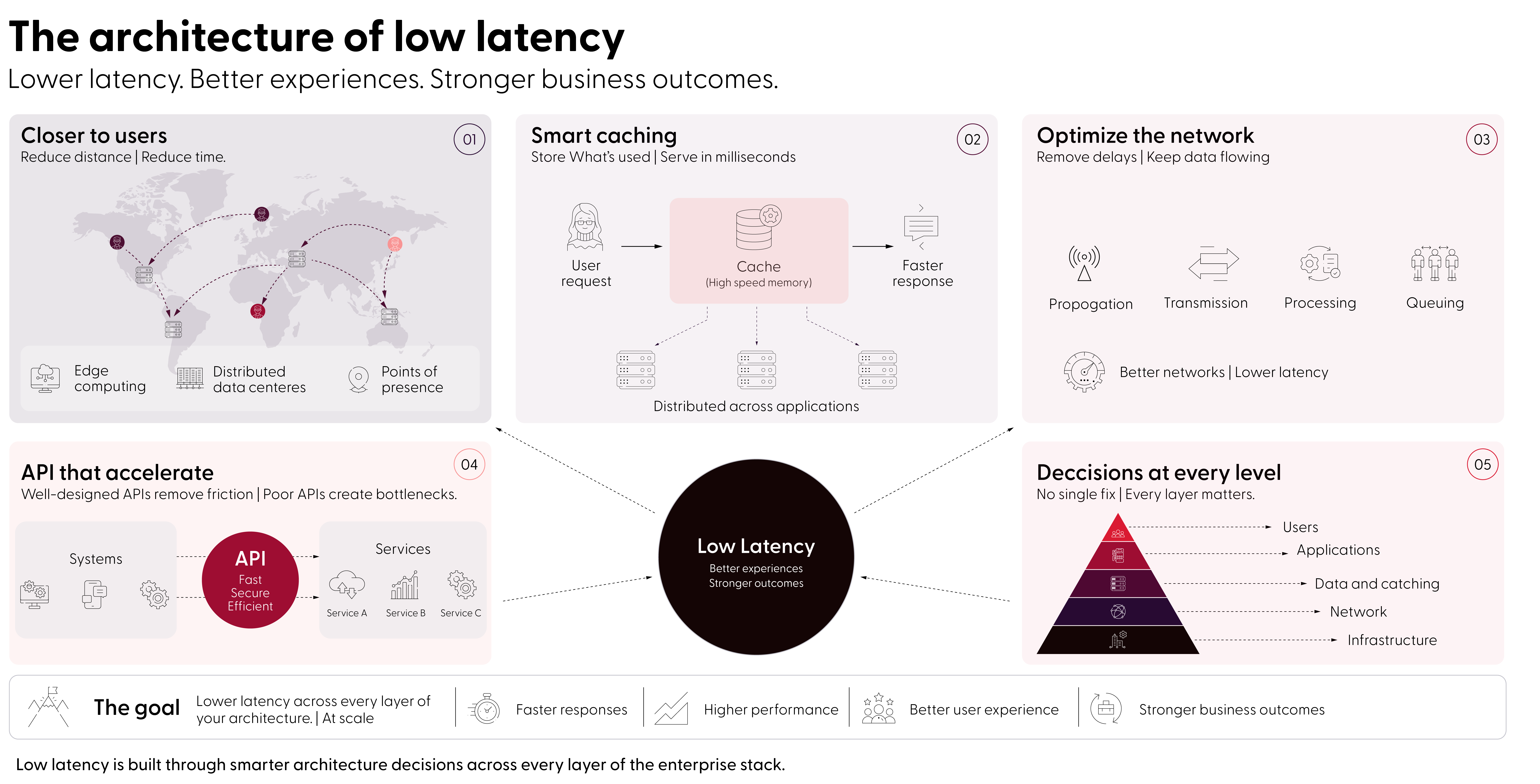
Reducing latency at enterprise scale requires decisions at multiple levels. No single intervention solves the problem.
Geography is a constraint most organizations underestimate. Data travels physical distances, and proximity to the end user is not a preference but a performance variable. Edge computing, distributed data centers, and point-of-presence networks move processing closer to users, often determining whether response times fall within acceptable thresholds or not.
Caching remains one of the highest-impact optimization strategies. By storing frequently accessed data closer to the user, enterprises reduce repeated retrieval delays and improve responsiveness at scale.
APIs are the connective tissue that either accelerates or constrains the entire architecture. Well-designed, low-overhead APIs allow data to move efficiently across systems, while poorly designed ones turn every integration point into a bottleneck. This is where enterprise application performance optimization demands alignment across infrastructure, application design, and integration strategy rather than isolated fixes.
Many enterprises invest in reducing latency but fail to measure whether their efforts are improving the experience that users actually have.
Average response times are insufficient. A strong average that masks a tail of slow responses still produces poor outcomes for a material portion of users. Behavioral signals, including bounce rates, session duration, and engagement depth, reveal whether latency is affecting how users interact with applications, not just how systems perform under controlled conditions. Tools like Google Lighthouse, New Relic, and Datadog support continuous monitoring, but the discipline is treating latency measurement as an ongoing operational practice rather than a periodic audit.
The enterprises shaping the next era of digital experience no longer treat latency as a one-time problem. Instead, they see it as an ongoing business priority that requires continuous investment, monitoring, and improvement throughout the product lifecycle.
This shift changes how they operate. Latency discussions now happen early in product planning, not after the systems are built. Infrastructure investments, on the other hand, are measured against customer experience and retention, not just technical benchmarks. And development teams now play a direct role in experience design because performance and user experience are no longer separate conversations.
At scale, even small delays can significantly impact customer satisfaction, engagement, and business outcomes. Faster systems create smoother experiences, stronger trust, and higher user retention, while slower experiences quietly increase friction across every interaction. As digital expectations continue to rise, the ones that prioritize enterprise application performance optimization will be those that set the standard for customer experience.
In the end, latency is no longer just an infrastructure concern that is hidden behind systems and dashboards, but more of a business differentiator that directly shapes perception, loyalty, and growth. The enterprises that are set to succeed tomorrow will not simply build faster systems, but instead build experiences that feel effortless, immediate, and almost invisible to the user. Because today, speed is no longer just a technical advantage, but defines how every digital experience is perceived, remembered, and trusted.
