
Multi-cloud vs Hybrid cloud: The architecture debate in 2026

Most enterprises didn’t choose their cloud strategy. It evolved around them. The real question in 2026 is whether the complexity you're running is intentional or just accumulated.
Cloud was supposed to mean more agility, but for many enterprises, it has meant more complexity, more cost, and more conversations about why the original migration business case never quite materialized.
This is the cloud debate of 2026.
Cloud strategy used to be straightforward: Pick a provider, migrate, and optimize later. That era is over.
Enterprises today are running more workloads across more environments than at any point in history. Data sovereignty laws are tightening, AI workloads are exploding, and legacy systems refuse to die. The real cost of getting infrastructure decisions wrong has never been higher.
The question today is no longer whether to use multiple environments. Most already do. The real question is whether that complexity is intentional and whether a deliberate multi-cloud or hybrid cloud model is guiding those decisions.
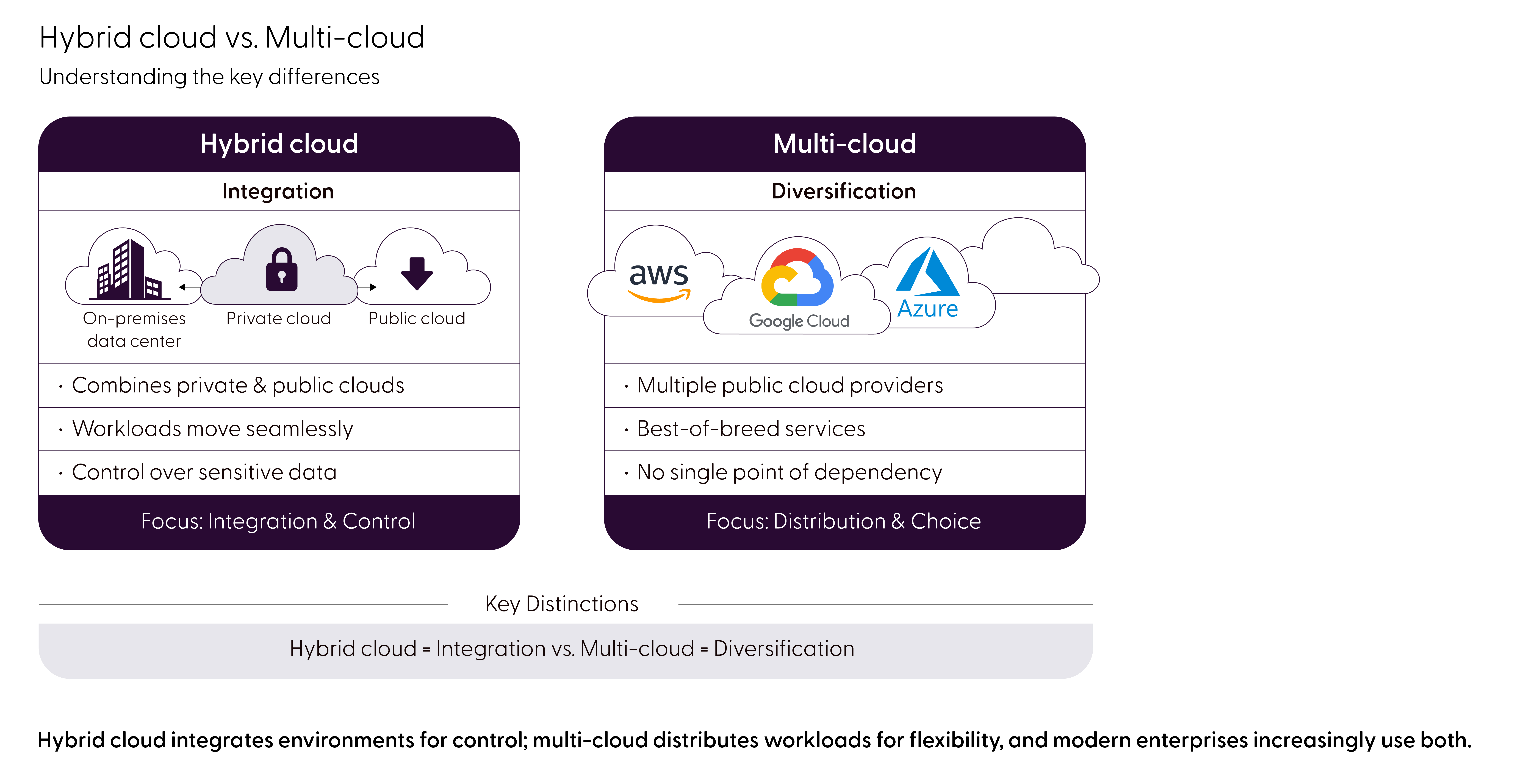
Before the debate, let's first get to the definitions.
On-premises data centers, private cloud environments, with one or more public clouds. The defining characteristic here is integration. Workloads move between environments based on policy, performance, and compliance requirements. The organization retains control over where sensitive data lives. This model reflects the growing importance of hybrid cloud computing in regulated and performance-sensitive environments.
AWS, Azure, Google Cloud, or others, without necessarily connecting them. The defining characteristic here is distribution. Each provider is chosen for what it does best. There is no single point of dependency.
Therefore, the important distinction is that hybrid cloud is about integration, while multi-cloud is about diversification. They are not mutually exclusive, and increasingly, more enterprises are running both simultaneously, whether they planned for it or not.
Vendor lock-in is the risk that often keeps the leadership up at night.
When your entire infrastructure sits with one provider, their pricing decisions become your pricing decisions, their outages become your outages, and their roadmap becomes your roadmap. Multi-cloud eliminates that dependency. Organizations can run their AI workloads where computation is most cost-efficient, store data where compliance demands it, and deploy applications where latency is lowest, all without being held to a single provider's terms. A mature multi-cloud strategy makes this flexibility intentional rather than accidental.
The numbers reflect this shift. Industry estimates suggest that over 85% of enterprises now operate in more than one public cloud environment. The driver here is not ideology, but the negotiating leverage and resilience that no single provider can offer.
AI is also adding a new dimension here. Training large models and running inference at scale requires specialized GPU infrastructure that is not evenly distributed across providers. Organizations with serious AI ambitions are finding that their cloud strategy must accommodate this and that the best general provider is not always the best choice for AI workloads. The ones extracting the most value from multi-cloud today are those using AI-driven cloud management platforms to optimize workload placement, cost, and performance across providers at a scale that manual oversight cannot match.
Not everything belongs in the public cloud. That reality is not going away.
Regulated industries such as healthcare, financial services, and government operate under data residency and compliance requirements that make full public cloud migration legally complicated and, in some cases, impossible. Sensitive workloads need to stay on-premise or in private environments. That is not a preference but a mandate.
This is where hybrid cloud computing becomes essential. It allows organizations to modernize without abandoning the infrastructure they cannot move, connecting legacy systems to cloud-native capabilities without forcing a ‘rip-and-replace migration’ that would take years and carry significant operational risk.
There is also a performance argument. Latency-sensitive workloads and real-time processing often perform better on private infrastructure than in shared public cloud environments. Hybrid cloud keeps those workloads where they belong while still accessing the scalability the public cloud provides. In our own engagements, we have assisted our clients across industries in designing these architectures that balance modernization with compliance, sequencing migration progressively rather than forcing binary choices between legacy and cloud-native.
This is where structured architecture thinking becomes critical, especially as organizations scale AI and data-driven workloads.
Most enterprises did not choose their current cloud architecture. It evolved over time.
Let's take an example: One team started with AWS for a project. Azure came in through a Microsoft agreement. An acquisition brought its own stack. Some legacy systems never moved. Over time, the architecture ends up running a mix of hybrid and multi-cloud, without ever really planning for it.
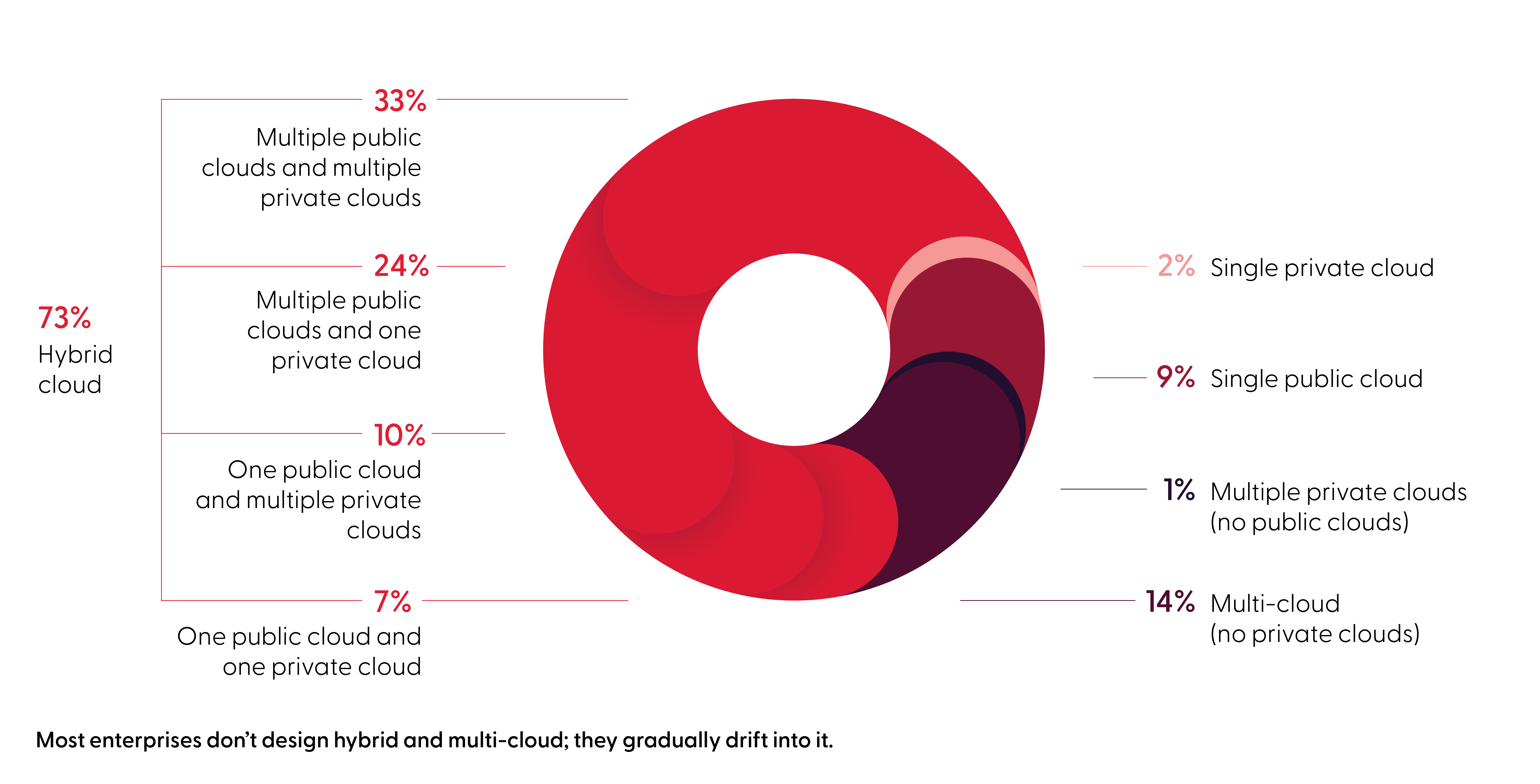
This is not the exception. It is the norm. And this is where the real risk lives, not in choosing the wrong model, but in operating a complex environment without a coherent framework to govern it. Complexity without intention is just technical debt.
There is no universally correct answer. But there are better and worse questions to ask.
The right questions are not “which cloud is best?” They are: Where does your data need to live, and why? Which workloads are genuinely portable and which are not? What does vendor concentration risk look like in your specific context? And most importantly, what is the operational cost of managing the complexity you are about to introduce?
In environments where AI workloads are scaling rapidly, cloud costs are rising unpredictably, and data sovereignty requirements are tightening, organizations need a more deliberate approach. The organizations getting this right in 2026 are not chasing a model but are building a strategy, one that starts with workload requirements and works backward to infrastructure decisions. For a deeper perspective, organizations are increasingly exploring structured approaches to cloud optimization.
Multi-cloud and hybrid cloud are not competing answers. They are tools. The question is whether your organization is using them deliberately or just living with the consequences of decisions that were never really made.
Cloud strategy in 2026 directly shapes resilience, cost control, innovation velocity, regulatory posture, and competitive agility. The ones getting this right are designing architectures around business outcomes: portability over lock-in, governance over fragmentation, and flexibility over reactive migrations.
Those that are not will still run hybrid and multi-cloud environments by simply inheriting them, with higher costs, more risk, and less control.
The difference is not the architecture itself; it is whether it is intentional.
