
AI-Driven Self-Healing Systems: Powering Autonomous and Resilient Digital Enterprises

Modern digital environments demand resilience at a scale and speed that traditional operations can no longer sustain. As systems grow more complex and interconnected, organizations must maintain stability while reducing downtime, operational overhead, and manual intervention. Self-healing AI addresses this challenge by autonomously detecting, diagnosing, and resolving issues, often before users notice, making resilience a built-in capability rather than a reactive response.
By combining real-time monitoring, machine learning, and predictive analytics, self-healing systems identify anomalies early and neutralize risks proactively. This marks a shift from traditional automation to truly autonomous operations that continuously safeguard system health. Industry forecasts indicate that nearly 71% of large enterprises are expected to deploy AI agents to support self-healing operations, underscoring its growing importance in modern digital operations.
Early self-healing concepts emerged in the late 1990s, when automation tools were introduced to reduce repetitive maintenance tasks. As complexity increased, data centers, networks, and cloud platforms began adopting mechanisms capable of diagnosing and correcting faults with minimal human input.
With advances in artificial intelligence during the 2010s, these capabilities evolved into modern self-healing AI platforms. Organizations started embedding adaptive intelligence into core systems to respond dynamically to infrastructure stress, performance fluctuations, and security threats. Today, these systems are becoming a foundational element of digital resilience and scalability.
Self-healing systems operate through three foundational mechanisms that allow them to manage faults autonomously.
These systems continuously monitor performance metrics such as CPU usage, memory consumption, network latency, and error logs to identify anomalies. Statistical models, thresholds, and machine learning algorithms detect deviations and flag early signs of failure
Once an anomaly is identified, AI-driven prediction models anticipate potential failures and trigger preventative measures. These may include load redistribution, security hardening, or automated configuration adjustments to neutralize threats before they escalate
When incidents occur, orchestration frameworks execute corrective actions such as service restarts, resource reallocation, or automated rollbacks. Learning loops refine responses over time, increasing accuracy and efficiency
Self-healing AI delivers value across multiple domains:
Automated traffic rerouting, service recovery, and high availability
Early vulnerability detection, isolation of compromised components, and real-time remediation
Traffic surge management, downtime prevention, and user experience protection, often achieving uptime above 99.9%
Automated detection and correction of pipeline failures to ensure analytics continuity
For a deeper perspective on how AI and intelligent automation are transforming industries, explore VRIZE’s latest insights.
AI-driven self-healing systems deliver both operational and financial value by improving reliability, reducing manual intervention, and enabling resilient digital environments capable of sustained performance.

Organizations deploying self-healing mechanisms report:
Productivity improves as IT teams shift from routine troubleshooting to innovation and strategic initiatives.
From a security perspective, automated detection and remediation shorten exposure windows and strengthen cyber defenses while strong governance remains essential to prevent automation-driven risks.
Self-healing systems introduce challenges that demand thoughtful implementation:
In regulated industries, compliance adds further complexity, requiring automation to be auditable and transparent. These challenges reinforce the need for phased adoption, governance, and continuous refinement rather than one-time deployment.
Evaluating effectiveness requires metrics that reflect detection accuracy, response efficiency, and learning capability:
Continuous learning is essential. As systems identify new patterns and refine responses, operational stability strengthens over time.
The future of digital operations is moving toward environments that anticipate issues, learn continuously, and elevate reliability as a core business capability.
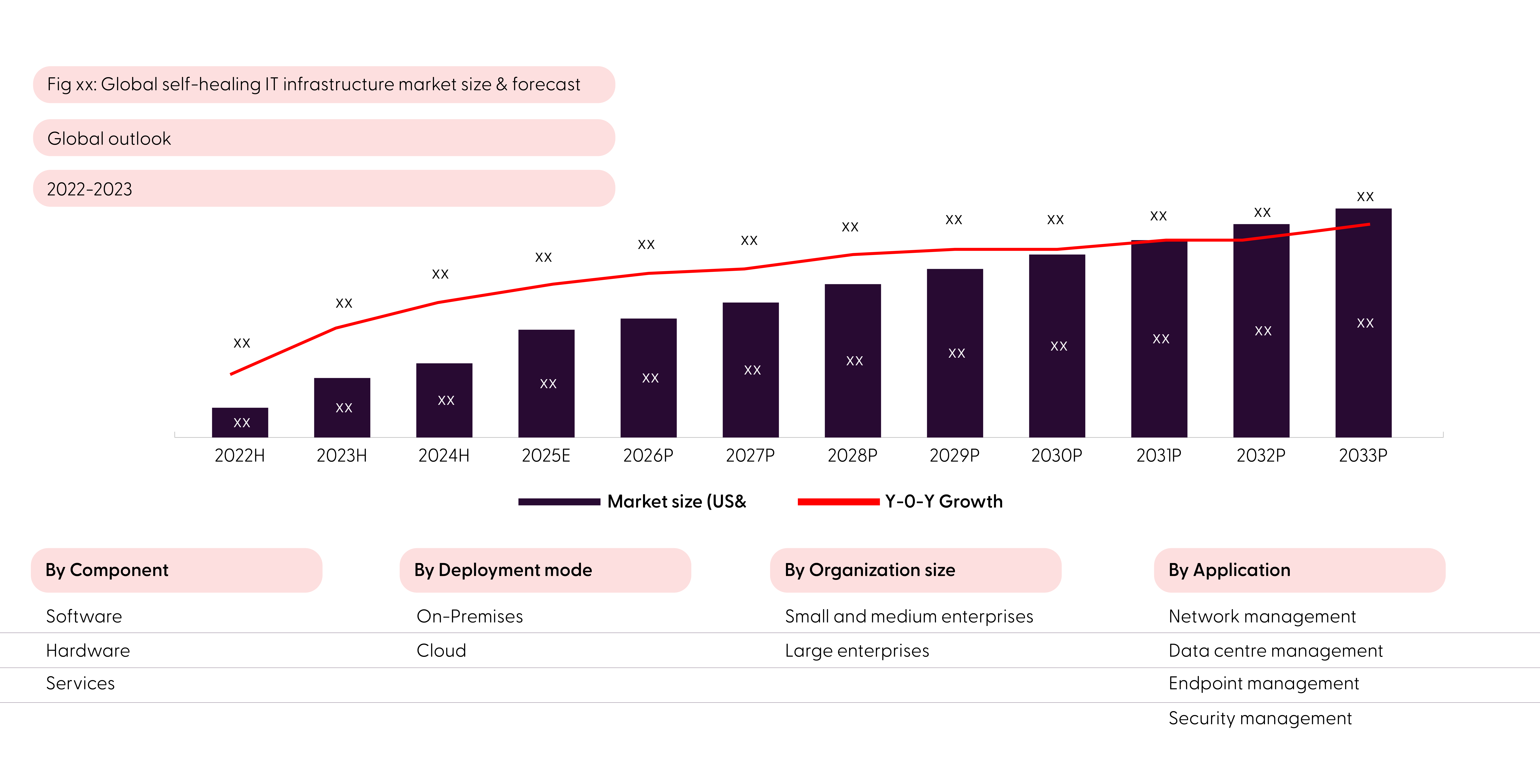
From $6.8B to $39.2B in less than a decade: self-healing IT infrastructure is becoming the backbone of next-gen digital operations.
According to DataIntelo, the global self-healing IT infrastructure market is projected to grow from USD 6.8 billion in 2024 to USD 39.2 billion by 2033.
As the global AI ecosystem expands and enterprises increasingly prioritize AI-led initiatives, organizations are preparing for a new operational paradigm defined by automation that is adaptive rather than reactive.
From VRIZE’s perspective, leadership in this next chapter will come from enterprises that embrace self-healing as a strategic foundation, not an add-on. Success will require seamless integration across cloud, hybrid, and legacy environments, supported by API-first design and strong governance. While integration complexity and false positives remain challenges, they increasingly represent milestones in the journey rather than obstacles that slow progress.
As digital ecosystems become increasingly interconnected, AI-driven self-healing systems will form the backbone of modern operations. Organizations that commit early to this transformation will set the standard for reliability and adaptability.
In this new landscape, self-healing is no longer about reacting to failure. It is about designing systems that anticipate, adapt, and endure.
For digital enterprises, self-healing is not merely an operational upgrade, it is a strategic foundation for scalable, resilient, and future-ready transformation. Explore how we help enterprises design autonomous, resilient digital ecosystems.
